How to Prepare for RECO Island Intake Process in South Florida
What people worry about before intake at a Delray Beach rehab If you are calling a Delray Beach rehab with your stomach in knots, that makes sense. Most people do. The fear is usually not just treatment. It is judgment, money, withdrawal, and the possibility that life will change before you feel ready. We hear […]
What people worry about before intake at a Delray Beach rehab
If you are calling a Delray Beach rehab with your stomach in knots, that makes sense. Most people do. The fear is usually not just treatment. It is judgment, money, withdrawal, and the possibility that life will change before you feel ready.
We hear that worry almost every week. Some people have searched “drug rehab near me” three times before they make the call. Others are trying to hold a job, answer texts, and quietly learn about the intake process at a Delray Beach rehab on a lunch break. That pressure can feel heavy. It does not mean you are failing.
Why insurance, judgment, and withdrawal fears show up before the first call
Insurance questions often come first because they feel practical. Judgment feels harder to name. Withdrawal fear sits underneath both. If you are worried about alcohol withdrawal support, cocaine detox Florida, opioid rehab Delray, or benzodiazepine withdrawal, your mind may keep jumping ahead to worst-case scenarios.
That is common. People often delay care because they do not know how long detox is, or what happens if they need South Florida detox. A good admissions process should make room for those fears without pushing you. It should ask clear questions, explain the next steps, and reduce confusion instead of adding to it.
How RECO Island intake preparation starts with honest answers, not pressure
Good intake work begins with truth, not performance. If you are unsure about alcohol use, prescription pill addiction, fentanyl treatment, or heroin recovery needs, say that. If you are also dealing with depression and addiction, anxiety treatment, bipolar disorder therapy, or PTSD treatment, say that too. Accurate answers help clinicians match care to your real needs.
“RECO Island is an amazing place! The environment is peaceful and beautifully designed — very clean, modern, and comfortable. The staff are kind, caring, and professional. They truly help you feel safe and supported throughout the recovery process. Highly recommended for anyone looking for real healing and a positive atmosphere! 🌿💫”- Md H., a 5 star review from RECO Island on Google Business Reviews
One client from Palm Beach County came in convinced he needed only outpatient support. During intake, it became clear that sleep loss, tremors, and a recent relapse meant he needed closer monitoring first. That kind of pivot is not failure. It is what honest screening is for.
What to have ready if you are checking Aetna, Cigna, Blue Cross Blue Shield, or out-of-network benefits
Before you call, gather the basics. Have your insurance card, photo ID, current city, and the best phone number for follow-up. If you have Aetna, Cigna, Blue Cross Blue Shield, or out-of-network benefits, that information helps admissions move faster. It also helps answer cost questions before they become stress.
If you want to review the details before speaking with admissions, look at insurance verification for Aetna, Cigna, Blue Cross Blue Shield, and out-of-network rehab coverage. Some people prefer self-pay options because they want privacy. Others want to know whether Florida rehabs that take insurance can help reduce out-of-pocket costs. Either way, clarity helps you make a steadier choice.
Why South Florida detox questions often come before people are ready to talk about treatment itself
Detox is often the first thing people ask about because it feels concrete. Treatment feels bigger and less defined. If you are trying to decide between a residential treatment facility, inpatient rehab Palm Beach County, or an outpatient program Delray Beach option, the detox question usually comes first. That is normal.
Here is the part most families miss: asking about detox does not mean you are overreacting. It means you are trying to stay safe. The same is true if you are searching for Florida addiction treatment, SAMHSA guidelines, or a private rehab that feels calm and confidential. The setting matters. So does the pace.
The paper trail that makes the RECO Island intake process move smoothly
The paperwork matters because it helps the clinical team see the whole picture. It is not busywork. It is part of safety. A complete intake file helps with insurance verification, medical planning, and privacy protections at a residential treatment facility.
In South Florida, people often arrive carrying more than one concern at once. Work schedules, childcare, traffic on Federal Highway, and the pace around Atlantic Avenue can all affect timing. The more complete your information is, the easier it becomes to build a plan that fits real life.
Which ID, insurance, and medical details help insurance verification go faster
Start with government ID, insurance card, medication list, and emergency contact information. If you have recent lab work, discharge papers, or hospital notes, bring those too. These details help admissions verify coverage and coordinate care without avoidable delays. They also help clinicians spot important medical issues early.
If you are checking in from Delray Beach, Boca Raton outpatient care, West Palm Beach mental health support, or Broward County rehab history, mention that. Geographically, it helps staff understand travel and follow-up logistics. If you want to know what to organize before the call, what to bring and share before checking into a Florida addiction treatment program is a useful reference.
What to gather if alcohol use, opioid use, cocaine use, or benzodiazepine withdrawal may be part of the picture
Be specific about timing, amounts, and last use if you can. That includes alcohol use, opioid use, cocaine use, or any benzodiazepine withdrawal concerns. Even rough estimates help. The intake team is not there to grade your answers. They are there to keep you medically safer.
If the pattern includes fentanyl treatment concerns, opioid rehab Delray needs, or cocaine detox Florida, that matters for withdrawal planning. A short history can be enough to flag risk. A few words about past seizures, blackouts, or severe panic also help. Those details may shape whether medical support is needed before anything else.
How a recent psychiatric history, medications, and past treatment help shape dual diagnosis treatment
Mental health history belongs in intake because substance use rarely stands alone. Depression and addiction often overlap. So do anxiety treatment, bipolar disorder therapy, and PTSD treatment. The co-occurring disorders model, used widely in evidence-based treatment, looks at both conditions together rather than pretending one causes the other in a simple way.
If you have been in treatment before, say what helped and what did not. If you take psychiatric medication, bring the names and doses. That information matters for dual diagnosis treatment and medication management. If you want a deeper overview of co-occurring disorders treatment in Delray Beach, this topic is worth reading carefully.
What to tell admissions about work, family, travel, and privacy needs near Delray Beach and Palm Beach County
Admissions can help more when they know your real constraints. Tell them if you work nights, care for children, or travel from outside Palm Beach County. Mention if privacy is a major concern because of your profession, family role, or community ties. Those details can shape communication and scheduling.
A woman from the Boca side once said she could not risk a loud, crowded waiting room because her employer knew too many people in town. That changed how the team planned her arrival and contact preferences. Small details matter. If you need extra discretion, confidential admissions and privacy at a residential treatment facility can help explain what that looks like.
Inside the clinical screening that decides what level of care fits best
The screening phase is where clinical judgment begins to sharpen. It sorts symptoms, withdrawal risk, safety concerns, and daily functioning into a clearer plan. This is where licensed clinicians decide whether someone needs residential treatment, partial hospitalization, intensive outpatient, or a different mix of support. That choice matters. The wrong level of care can make recovery harder. The right one can reduce stress quickly, even if the work ahead still feels serious. ### How bio psych social evaluation and initial evaluation help sort symptoms from substance use patterns 
A bio-psycho-social evaluation looks at body, mind, and environment together. An initial evaluation looks at current symptoms, substance use, and immediate risks. Together, they help separate what is driven by withdrawal from what may come from trauma, mood, or life stress. That distinction is central to dual diagnosis treatment.
If you want to understand the screening better, review bio-psycho-social evaluation for dual diagnosis treatment. That kind of assessment can reveal why someone appears “just tired” when they are actually in withdrawal, or why panic looks different when alcohol has been involved. Clear assessment protects against guesswork.
When a psychiatric evaluation matters for depression and addiction, anxiety treatment, bipolar disorder therapy, or PTSD treatment
Psychiatric evaluation becomes especially important when mood symptoms are severe, ongoing, or mixed with substance use. Depression and addiction often reinforce each other. Anxiety treatment may need to account for panic that started before use, or panic that worsened after it. Bipolar disorder therapy and PTSD treatment require similar care, because symptoms can look similar to intoxication or withdrawal.
A recent psychiatric history, hospital stay, or medication change should never be hidden. It helps the team understand what needs monitoring. If you are unsure what a psychiatric evaluation includes, psychiatric evaluation for depression, anxiety, PTSD, and bipolar disorder can make the process less mysterious. The goal is accuracy, not labels.
Why the difference between residential treatment facility, partial hospitalization program, and intensive outpatient can change the whole plan
Level of care shapes daily structure. A residential treatment facility offers the most contained environment. A partial hospitalization program, or PHP, gives strong daytime support without overnight stays. An intensive outpatient program, or IOP, usually allows more independence while still providing frequent clinical contact. The right fit depends on risk, support, and stability.
Level of careTypical focusBest fit whenResidential treatment facility24-hour structure and monitoringWithdrawal risk, unstable housing, or strong relapse riskPartial hospitalization programHigh clinical support during the dayYou need intensive care but can sleep elsewhereIntensive outpatientFlexible treatment with frequent sessionsSafety is stable and you can manage daily responsibilitiesIf you are comparing options, what a residential treatment facility in Delray Beach is like can help. So can how PHP and IOP differ in Palm Beach County treatment planning. The right level is not about status. It is about support.
How medical treatments, medication management assessments, and medication-assisted treatment may be considered for opioid rehab Delray or alcohol withdrawal support
Medical screening may include medication management assessments when safety is a concern. That can matter for opioid rehab Delray, alcohol withdrawal support, and severe cravings. FDA-approved options like Suboxone maintenance or Vivitrol injections may be considered in some cases, depending on the clinical picture and patient preference. These are tools, not magic fixes.
For a deeper look at how medication-assisted treatment helps with opioid recovery, the main idea is simple: medication can lower risk while people build coping skills. That aligns with SAMHSA guidance and NIDA’s co-occurring care model. It also fits evidence-based treatment, where the plan is shaped by real physiology, not willpower alone.
What happens after admission when the real work of recovery begins
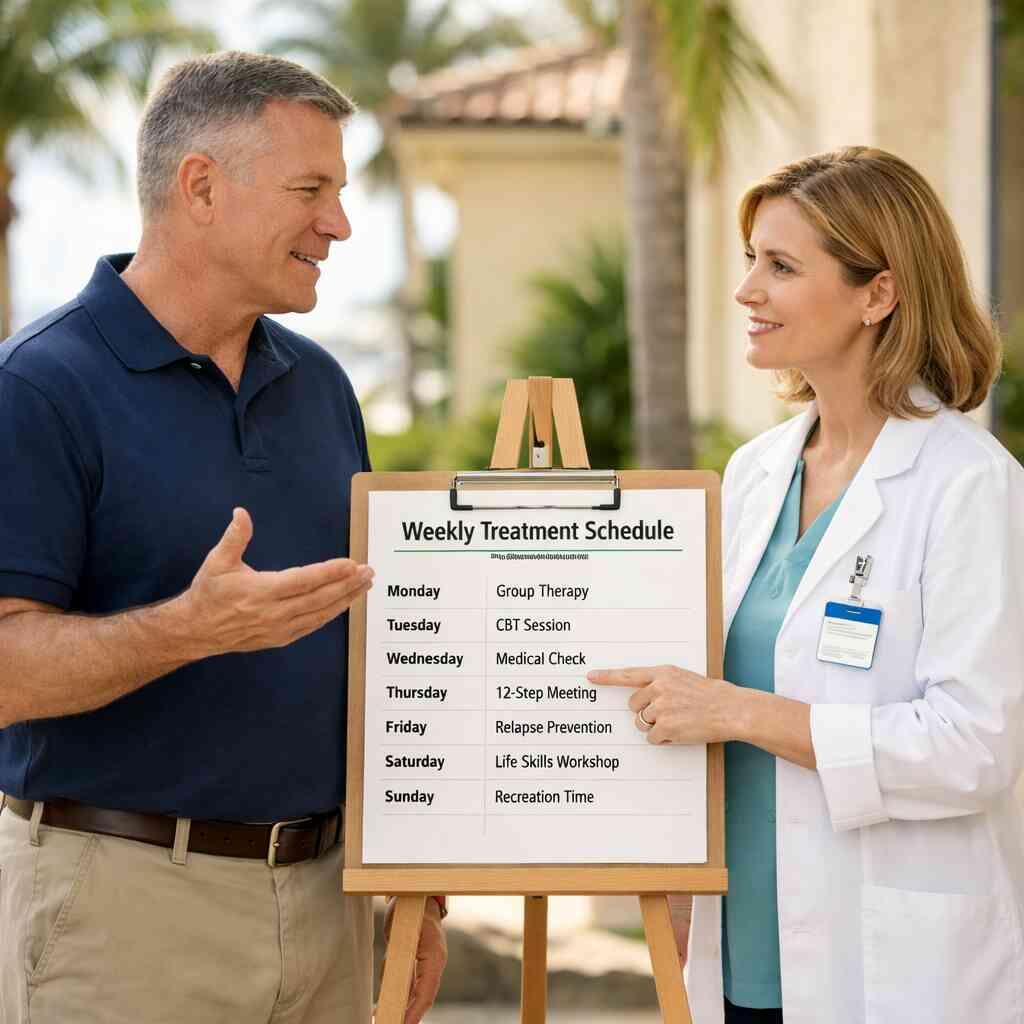
Admission is not the finish line. It is the point where structure begins to replace chaos. Many people feel a strange mix of relief and fear on the first day. That is normal, especially if this is your first time in treatment or you have tried before.
The daily rhythm matters more than people expect. Sleep, meals, therapy, and quiet time all start to support the nervous system. Recovery begins to feel less abstract and more lived.
How daily structure, group therapy, and individual therapy create steadier footing in early care
Daily structure gives the brain fewer chances to spiral. Group therapy activities create repetition, accountability, and shared language. Individual therapy gives room for private work that cannot always happen in a group. Together, they create a stronger base for early recovery.
If you want to see how that structure may look inside what to expect in RECO Intensive rehab intake in Delray Beach, think of it as moving from uncertainty to routine. That can feel boring at first. It is not boring. It is stabilizing.
Where CBT, DBT, EMDR trauma therapy, mindfulness meditation, and heart regulation practices may fit in a plan
Cognitive behavioral therapy, or CBT, helps people notice unhelpful thought loops and replace them with clearer actions. Dialectical behavior therapy, or DBT, teaches emotion regulation and distress tolerance. EMDR trauma therapy can help some people process traumatic memories without staying trapped in them. Mindfulness meditation and heart regulation practices may also support nervous system calm.
These methods fit different needs. They are often used in trauma therapy South Florida programs, especially when PTSD treatment, anxiety, or shame are part of the story. They are not quick fixes. They are skills that improve with practice. On the projects we’ve finished this year, the people who engaged steadily with these tools tended to build better coping routines.
Why family therapy, case management, life skills training, and aftercare planning matter as much as the intake itself
Recovery does not happen in a vacuum. Family therapy helps people communicate with less blame and more clarity. Case management can connect you with practical supports. Life skills training may cover budgeting, scheduling, sleep routines, or job readiness. Aftercare planning starts early because discharge without a plan can leave a dangerous gap.
If you need a strong continuity plan, family therapy and support in recovery at RECO Island and aftercare planning for long-term recovery after treatment are worth reviewing. Families often feel helpless before they understand their role. Learning what helps can change the whole atmosphere at home.
How to think about sober living resources, alumni support, and the Delray Beach recovery community before you leave the building
A discharge plan should include sober living resources when appropriate. It should also consider alumni support, support groups, and the Delray Beach recovery community. People often do better when they have a place to land after structured care ends. That might include 12-step alternatives, SMART Recovery, or a mix of both.
If you want to stay connected after treatment, RECO Intensive alumni can be part of a longer runway. In Delray Beach, proximity to the coast, quiet neighborhoods, and sober things to do Delray can make new routines feel more possible. What matters most is not perfection. It is having a plan that fits your life after you leave the building. One practical move you can make today is to gather your ID, insurance card, and medication list, then call admissions with those three items in front of you.
Frequently Asked Questions
Question: What should I have ready before the RECO Island intake process if I’m calling a Delray Beach rehab for Florida addiction treatment?
Answer: Before you call RECO Island, it helps to have your government ID, insurance card, medication list, and a reliable phone number ready. If you have Aetna, Cigna, Blue Cross Blue Shield, or out-of-network benefits, that information can make insurance verification smoother and reduce delays. It is also helpful to know your current city, any recent treatment history, and whether you may need South Florida detox, outpatient program Delray Beach support, or a residential treatment facility. If you are unsure about the level of care, that is okay. The intake process is designed to help licensed clinicians understand your needs and guide you toward the next step with clarity and compassion. If you want to prepare ahead of time, gathering these basics is one of the simplest ways to make the first conversation easier.
Question: How does RECO Island determine whether I need South Florida detox, residential treatment facility placement, PHP, or intensive outpatient care?
Answer: RECO Island uses an intake process that looks at your substance use, withdrawal risk, mental health history, daily functioning, and support system. That screening helps licensed clinicians decide whether residential treatment facility care, a partial hospitalization program, or intensive outpatient is the safest fit. If alcohol withdrawal support, cocaine detox Florida needs, opioid rehab Delray concerns, benzodiazepine withdrawal, fentanyl treatment, or heroin recovery risks are part of the picture, those details matter a lot. The goal is not to overreact; it is to place you where you can stabilize safely. For some people, dual diagnosis treatment or mental health IOP may be the better match, especially if depression and addiction, anxiety treatment, bipolar disorder therapy, or PTSD treatment are also part of the story. A thoughtful placement protects your safety and helps treatment start on solid ground.
Question: How do dual diagnosis treatment and co-occurring disorders care fit into the intake process at RECO Island?
Answer: Dual diagnosis treatment is an important part of intake because substance use and mental health symptoms often overlap. RECO Island’s screening looks for co-occurring disorders such as depression and addiction, anxiety treatment needs, bipolar disorder therapy, and PTSD treatment concerns so the clinical team can create a more accurate plan. If you are taking psychiatric medication, have a history of hospitalization, or have tried treatment before, those details help licensed clinicians understand what support you may need next. Depending on the assessment, care may include evidence-based treatment, cognitive behavioral therapy, dialectical behavior therapy, EMDR trauma therapy, or a mental health IOP. This approach is especially helpful for people searching for a private rehab or an alcoholism treatment center that treats the whole person rather than only one symptom at a time.
Question: What can I expect from treatment after intake at RECO Island, including family therapy, group therapy activities, and aftercare planning?
Answer: After intake, treatment typically becomes more structured and supportive. Depending on your level of care, you may take part in group therapy activities, individual counseling, family therapy, and skills-based support that builds coping skills and relapse prevention. Many people also benefit from case management, life skills training, nutritional counseling, and holistic recovery practices like mindfulness meditation, yoga therapy, or art therapy when appropriate. RECO Island also emphasizes aftercare planning early, because long-term recovery usually needs a bridge beyond the first phase of treatment. That can include sober living resources, 12-step alternatives, SMART Recovery, alumni support, and continued outpatient support. The aim is to help you leave with a plan, not just a discharge date.
Question: How can I tell if RECO Island is the right Florida addiction treatment option for me if I’m searching for a drug rehab near me?
Answer: If you are comparing how to choose a rehab, start by looking for a program that feels clinically thorough, compassionate, and transparent. RECO Island is located in Delray Beach and serves people looking for South Florida recovery in a coastal healing environment, but the most important factor is whether the intake process helps you feel understood. Ask whether the program supports dual diagnosis, insurance verification, outpatient program Delray Beach options, residential treatment facility care, and aftercare support. It also helps to ask about privacy, family weekend, gender-specific treatment, young adult rehab, veterans addiction help, LGBTQ+ affirmative treatment, and professional’s program support if those are relevant to you. If you are reviewing RECO Intensive reviews or exploring RECO Intensive alumni resources, use that information as part of your research, but focus on whether the program’s approach matches your needs. A strong fit usually feels clear, respectful, and medically responsible from the first conversation.
Question: Does RECO Island help with medication-assisted treatment, insurance verification, and planning for long-term recovery after intake?
Answer: RECO Island’s intake process is designed to identify what kind of support may be appropriate, including medication management needs and possible medication-assisted treatment when clinically indicated. For some people, options like Suboxone maintenance or Vivitrol injections may be considered as part of opioid rehab Delray or alcohol recovery planning, depending on the evaluation and the treating team’s recommendations. Admissions can also help with insurance verification for Aetna, Cigna, Blue Cross Blue Shield, or out-of-network benefits, which can make the process less stressful. Just as important, intake is where aftercare planning starts. That may include sober living resources, intensive outpatient, support groups, and other Florida recovery resources that support long-term recovery. If you want a treatment experience that centers dignity, evidence-based treatment, and practical next steps, RECO Island aims to make the path forward feel clearer from day one.